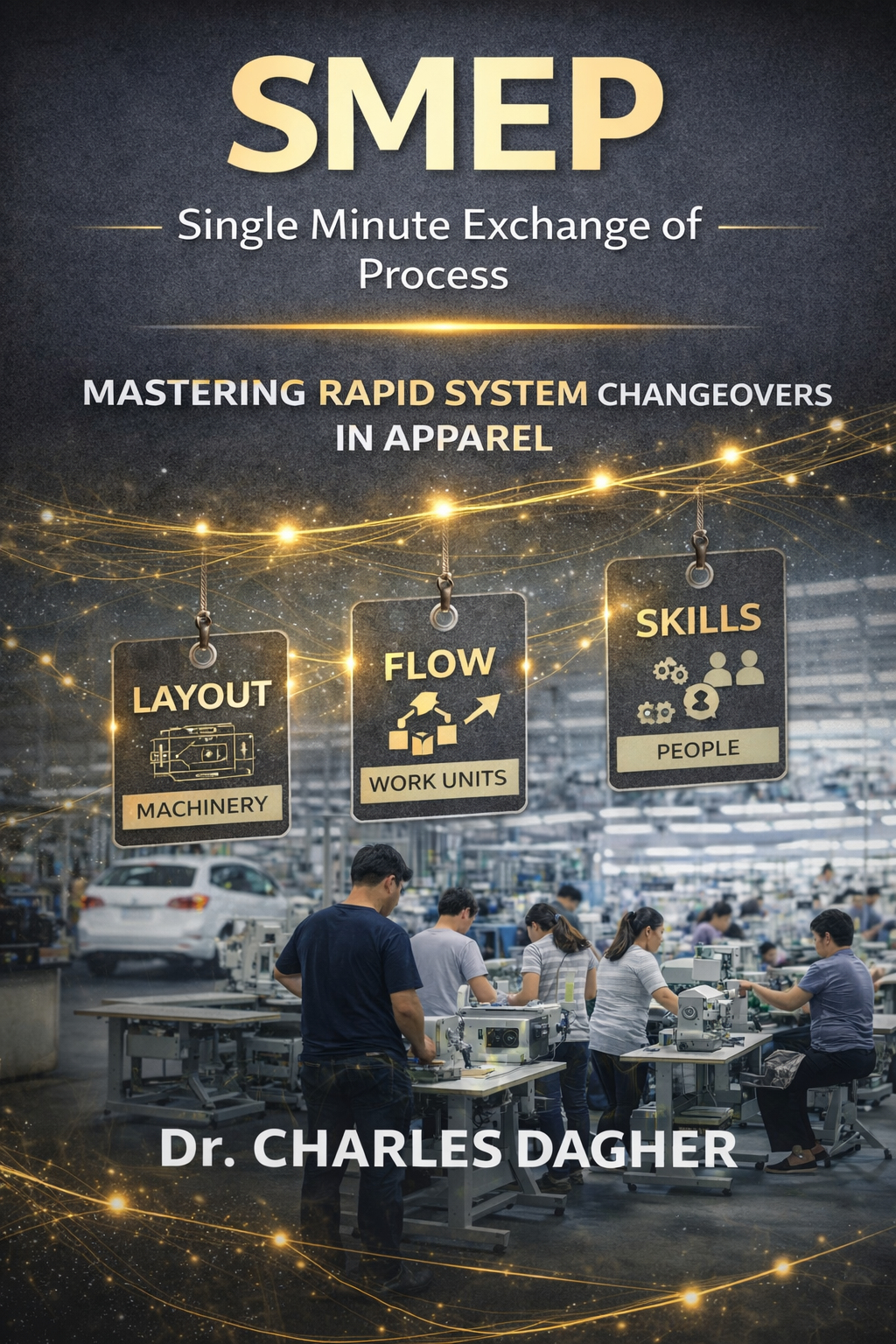
Why SMEP Was Born: Moving Beyond the SMED Illusion
For years, apparel factories have borrowed Lean thinking from capital-intensive industries without questioning the context behind its tools. Nowhere is this more problematic than in the case of SMED—Single Minute Exchange of Dies. Designed for stable automotive environments, SMED focused on tool replacement within a fixed line, with predictable flow, static layouts, and synchronized teams. It was never built for volatility.
In the apparel industry, however, an order change is not just a tool change. It dismantles and reshapes the entire production system—machines shift, operators reassign, skill maps break, flow logic collapses, and support functions must reset. What gets labeled as a “changeover” is, in truth, a system-wide reconfiguration event.
Applying SMED in this context doesn’t accelerate agility. It distorts it. Factories end up chasing cosmetic Lean—better visuals, tighter routines—but the system remains unstable. The pressure falls on people, not design. Speed is measured in minutes, while real disruption lasts hours or days.
At nexusX, under the SmartLean Agility™ framework, we have reengineered this logic into SMEP: Single Minute Exchange of Process.
SMEP is not a faster tool swap. It is a system changeover method that synchronizes setup, machinery layout, skill readiness, work unit design, operator movement, and flow balancing—treating changeover as an engineered system, not a task.
This eBook introduces SMEP as the apparel industry’s first true system-level response to volatility. It is designed not for routine, but for adaptability. It does not patch fragility. It builds coherence.
Write your text here